

- Vulnerabilities associated with a dependency’s current version and those of its transitive dependencies.
- Resolved vulnerabilities associated with a dependency’s later versions and those of its transitive dependencies.
- Heuristic factors that influence the probability of breaking changes.
- Program analysis to directly identify breaking changes.
- The latest version of the software
- The latest vulnerable free version
- The most impactful update with moderate evidence of breaking changes
- The most impactful update with low evidence of breaking changes
License
Upgrade impact analysis is available with the Endor Pro license.
Upgrade impact analysis is available with the Endor Pro license.
Remediation risk
Endor Labs evaluates the remediation options for each recommended upgrade and assigns a remediation risk. To assign remediation risk, Endor Labs looks for breaking changes associated with the upgrade and conflicts between dependency versions. There are three categories of remediation risk.- High Remediation Risk: This risk level is assigned when Endor Labs has high confidence that a breaking change will occur.
- Medium Remediation Risk: This risk level is assigned when Endor Labs has identified a potential breaking change but has low to moderate confidence in its impact. It is also assigned in cases of major version conflicts that could be affected by the upgrade.
- Low Remediation Risk: This risk level is assigned when there is minimal or no evidence suggesting that a breaking change will occur. The absence of evidence does NOT guarantee that it will not break your application.
Breaking changes
Breaking changes may necessitate refactoring your code to complete an upgrade due to newly introduced incompatibilities. A breaking change may occur due to the following criteria:- API Changes: When the public interface of a library changes, such as through renaming or removing functions, altering function signatures, or modifying expected input or output parameters.
- Behavioral Changes: When the underlying behavior of a function or method changes, even if the interface remains the same. This can lead to unexpected results or introduce issues.
- Dependency Updates: When a dependency of a dependency, that is a transitive dependency, introduces breaking changes, it can affect the higher-level dependency.
- Deprecations and Removals: When deprecated features are finally removed or altered significantly.
- Configuration Changes: When the configuration format or options for a library change.
- Changes in Supported Platforms: When a library drops support for certain platforms or versions of platforms, for example, an older version of Go.
Dependency conflicts
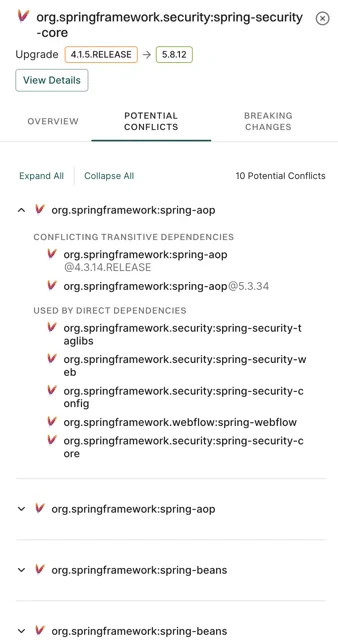
Dependency conflicts occur when different parts of a software project require different versions of the same dependency. These conflicts can cause various issues, such as build failures, runtime errors, or unexpected behavior. When there are major or minor version conflicts in your dependency graph, the impact can vary depending on the nature of the conflicts and the specific dependencies involved. While conflicts do not necessarily guarantee that updating will impact your application, they increase the likelihood that changes may affect it.View remediation recommendations
To view Endor Labs remediation recommendations:- Sign in to Endor Labs and select Projects from the left sidebar.
- Select the project for which you want to view the remediations.
- Select Remediations to view the list of remediation recommendations available for the project.
Review recommendations
Endor Labs lists the remediations available for the project based on the main branch of the project. You can filter the remediations by Show Only Reachable remediations, the Remediation Risk, and the time period. Additionally, you can export all findings to a CSV file.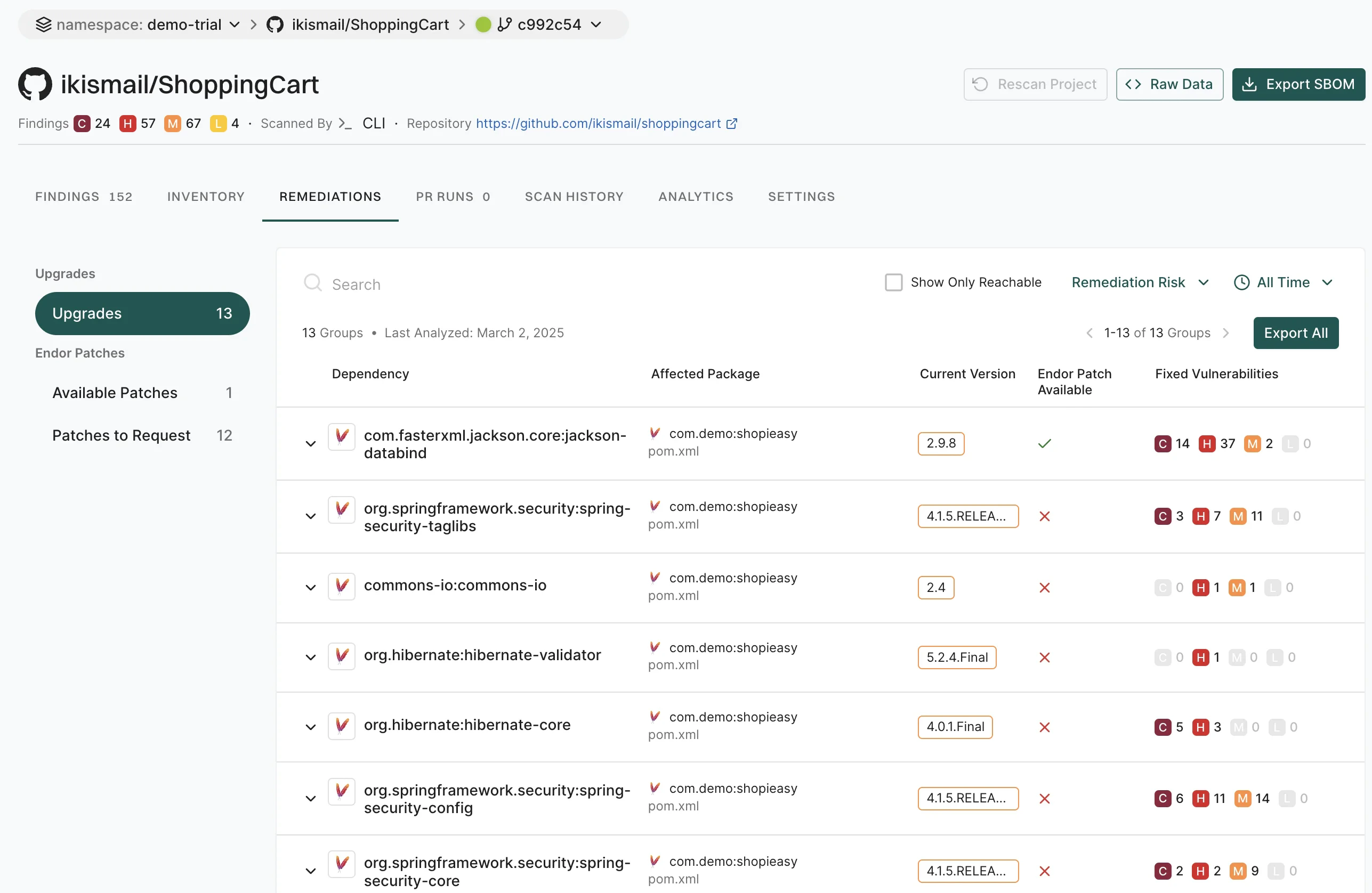
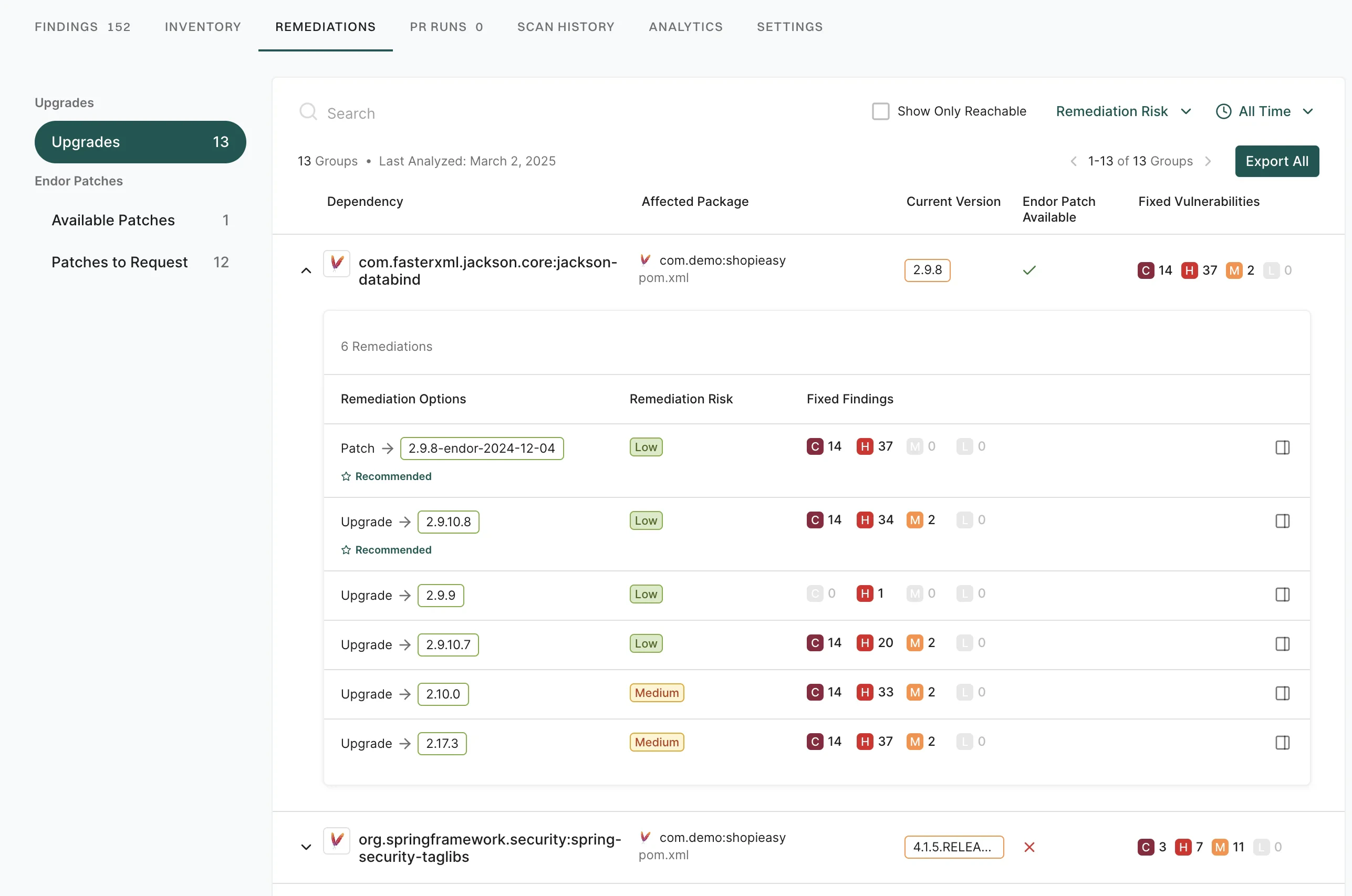
Review remediation risk
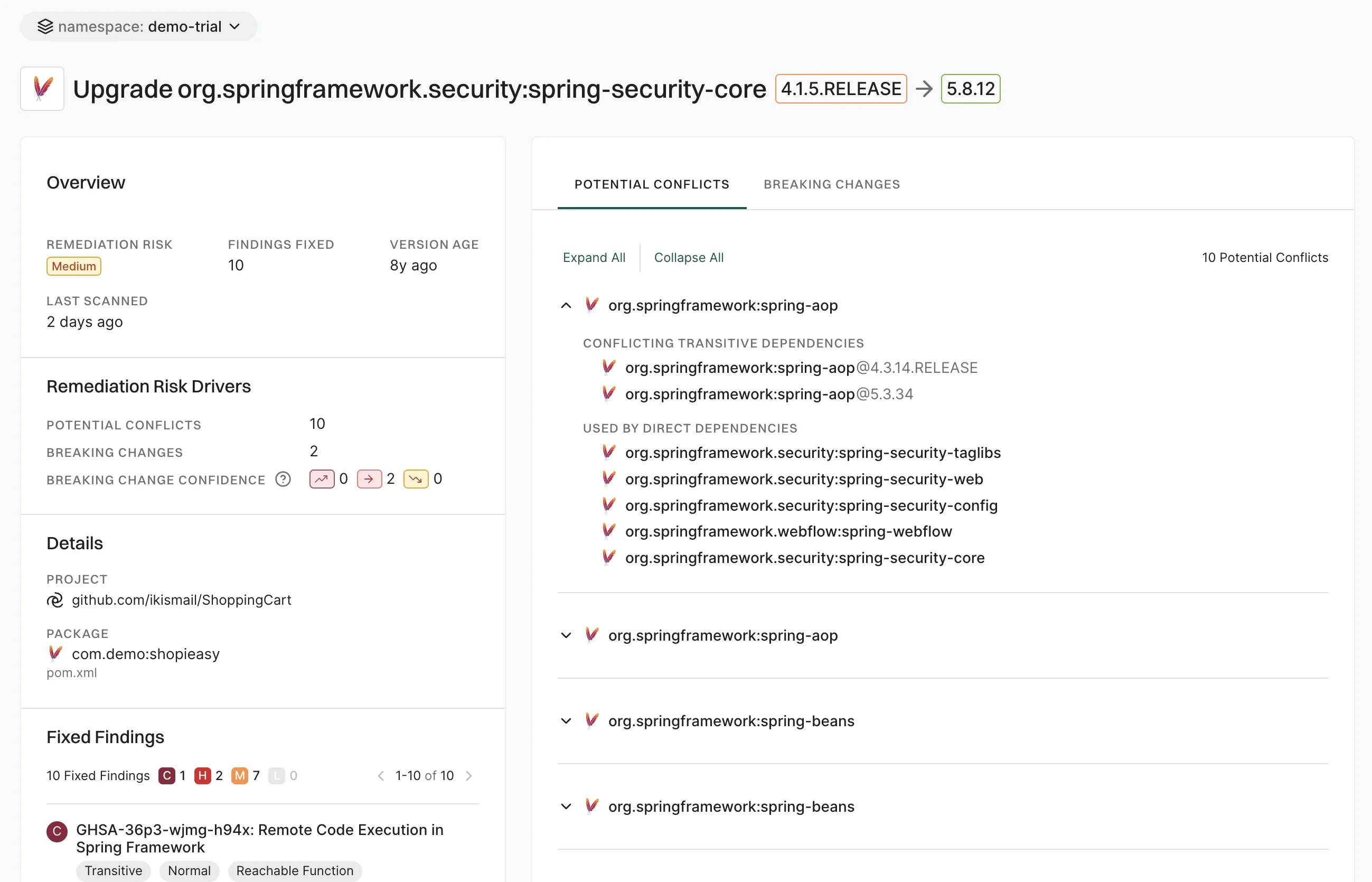
Select an upgrade option to view the details of this upgrade path on the right sidebar.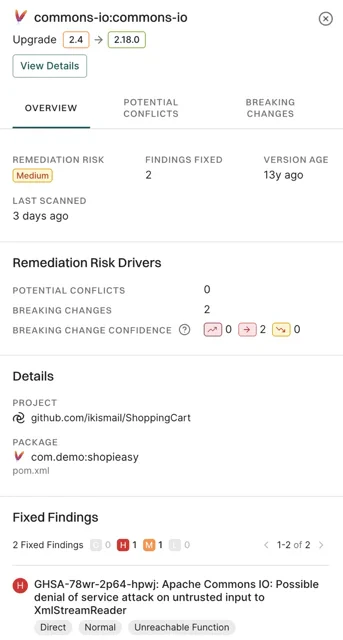
- An overview of the remediation including the remediation risk, version age, latest scan information, and findings fixed.
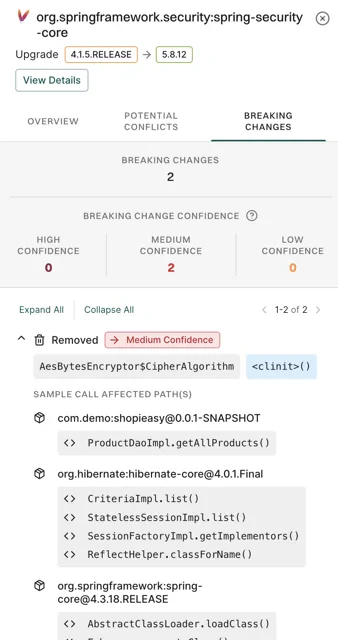
- The Remediation Risk Drivers with the potential conflicts and breaking changes. Remediation risk drivers also influence the breaking change confidence, which denotes how likely your project’s functionalities can be negatively impacted due to the upgrade.
- The Details of the package including the project, package, and version details.
- The Fixed Findings with the details of the vulnerabilities fixed by this upgrade.
Limitations of upgrade impact analysis
Upgrade impact analysis has the following limitations:- Upgrade recommendations are proposed only for OSS packages.
- Upgrade recommendations are based on the data available in the main branch of the project.
- Upgrade impact analysis never recommends version downgrades.
- Upgrade impact analysis does not propose upgrades for container dependencies, GitHub Actions dependencies, and approximate dependencies.
- Upgrade recommendations for groups of direct dependencies are not supported.
- Upgrade impact analysis for a dependency is at the project level and not across the tenant or a namespace.
- Upgrade recommendations are suggested only for the dependencies with vulnerabilities.
- Version constraints are excluded in the upgrade recommendations.